Canada sidesteps recession—but key risks remain
Author details
Prince Owusu
Senior Economist, Economic and Political Intelligence Centre (EPIC)
Karicia Quiroz
Economist | Country & Sector Intelligence
In this article:
- Canada’s recession history highlights ongoing risks for 2026
- Downside risk No. 1: Trade disruptions and tariff shocks
- Canada’s export dependence amplifies trade risk
- What are the Canadian sectors most exposed to tariff shocks?
- Downside risk No. 2: Weakening consumer demand
- The bottom line: Canada’s economy remains exposed to key shocks
In early 2025, concerns about a looming Canadian recession were widespread. Canada was facing tariff challenges from the United States, its largest trading partner, while still grappling with slow growth following post-pandemic high inflation. Thankfully, those fears didn’t materialize.
Aggressive Bank of Canada interest rate cuts and broad tariff exemptions—under which roughly 90% of Canadian goods exported to the U.S. remained exempt under the Canada-United States-Mexico Agreement (CUSMA)—provided meaningful economic support.
As a result, the Canadian economy moved past the peak of these tariff-related shocks and a recession stemming from them is no longer the base-case scenario in our economic outlook. Together, these factors helped avert a worst-case outcome and significantly eased near-term recession fears. These developments align with the risks outlined in EDC’s Top 10 global risks for Canadian exporters in 2026, where trade fragmentation and policy uncertainty rank among the most significant threats to growth. Data in this article reflect information available as of January 2026.
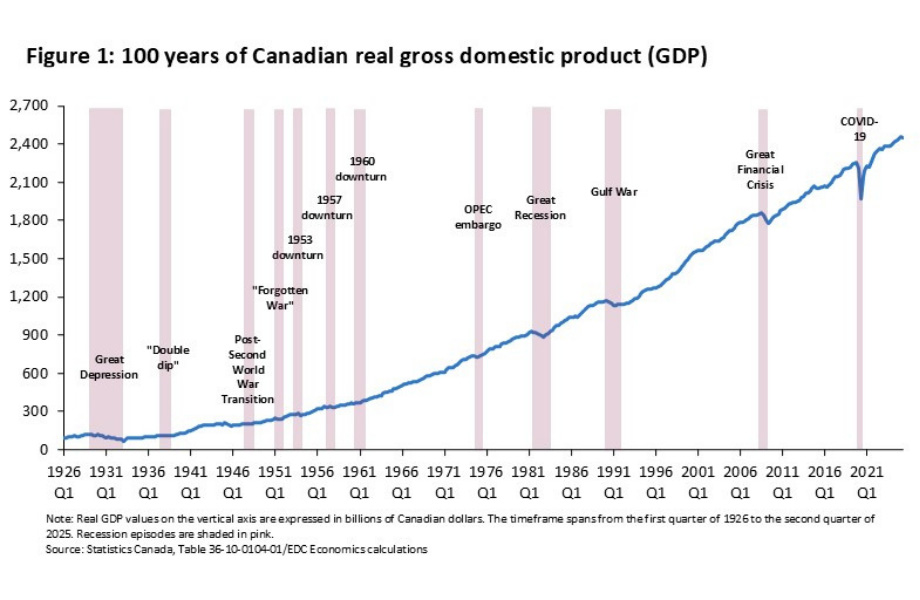
And yet, Canada’s economic outlook remains vulnerable. Several risks could still knock the economy off its current course and reignite recession concerns—including shocks that have historically weighed on growth. Over the past century, Canada has experienced 12 recession periods (see Figure 1), underscoring how external disruptions and domestic imbalances can quickly alter economic trajectories.
This analysis doesn’t forecast an economic recession. Instead, it identifies two vulnerabilities that could still destabilize Canada’s economy. Specifically, we assess two key downside risks that warrant close attention and could—if they materialize—revive recessionary pressures.
The most significant downside risk to Canada’s economic outlook is a renewed escalation in trade disruption—particularly higher tariffs imposed by major trading partners such as the United States and China. Risks could also emerge through adverse changes to CUSMA, which is scheduled for review in mid-2026. Any revisions that materially restrict Canadian exporters’ access to the U.S. market would significantly influence trade flows, business investment and ultimately, growth.
In today’s volatile geopolitical environment, trade policy shocks can arise and shift rapidly. Recent rhetoric—including warnings that Canadian goods entering the U.S. could face punitive tariffs if Canada deepens trade ties with China—illustrates how quickly downside risks can emerge. While such scenarios aren’t part of our base-case outlook, sudden and severe trade disruptions have the potential to undermine confidence and tip the Canadian economy into recession.
You should also check out
-
ArticleJanuary 07, 2026
Top 10 global risks for Canadian exporters in 2026
Discover the Top 10 global risks for Canadian exporters in 2026—from CUSMA talks to trade wars and recession threats. Learn how to prepare with EDC insights.
Canada is particularly exposed to trade shocks given the concentration of our export profile. About 74% of Canadian goods and services exports are destined for the U.S. (70%) and China (4%). Large-scale changes to these trade relationships—such as the introduction of new, elevated tariffs—would create significant uncertainty for exporters. Even the threat of disruption can prompt firms to delay investment, reassess supply chains, or adjust long-standing business models.
In turn, reduced investment and export activity could lead to job losses and rising unemployment, dampening household demand and amplifying the broader economic impact. This high trade dependence underscores why escalating tariffs, or adverse CUSMA outcomes, remain one of the important risks to Canada’s growth outlook.
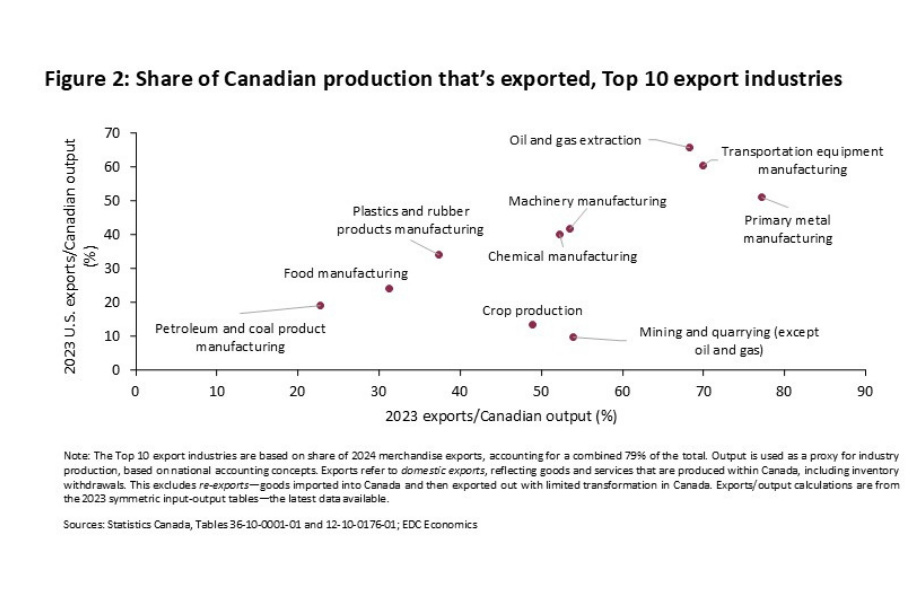
Within Canada’s merchandise trade, sectors such as oil and gas extraction, primary metal manufacturing (notably, steel and aluminum) and transportation equipment manufacturing (notably, motor vehicles and parts) could be highly vulnerable to new U.S. tariff shocks (see Figure 2). This is due to these sectors’ high share of Canadian production that’s exported (68%-77%) with a significant share (51%-66%) going to the U.S. market. However, the deep integration and sizable contribution of some sectors, like energy, in the U.S. economy reduces the risk faced by some of these sectors.
Other sectors that are prone to global trade vulnerabilities, including crop production, mining and quarrying, machinery manufacturing and chemical manufacturing, export between 49% and 54% of what’s produced. Overall, this highlights the potential impact from trade shocks to a variety of Canadian sectors—spanning entire supply chains from raw materials to finished products.
Sector spotlight: Autos, steel, aluminum and forestry
As of November 2025 (latest data), the U.S. effective tariff rate (ETR) on Canada was 3.7%, based on U.S. Census Bureau data—with that number dropping to 0.8% when excluding Canadian motor vehicles, parts, steel and aluminum (not factoring derivative products). Though these values are relatively low, sector-specific tariffs introduced in 2025 are already weighing on key Canadian industries. Below are some details on the sectors that are the most vulnerable:
- Motor vehicles and parts: With 82% of Canadian motor vehicle production exported to the U.S., the sector is highly exposed to U.S. tariff risk—even with CUSMA exceptions. The U.S. tariffs have already weighed on the sector. According to Statistics Canada, motor vehicles and parts’ real GDP averaged $17.2 billion from January to November 2025—down 1.6% year-over-year (y/y). In that same period, the sector faced an estimated loss of 6,887 jobs—of which 6,214 were cut in motor vehicle parts manufacturing, the sector’s largest employer. Further trade disruptions to this sector could have a ripple effect across industries feeding the supply chain, including steel, aluminum, chemicals, plastics, machinery, electronics and logistics.
- Steel and aluminum: The U.S.’s 50% tariffs on steel and aluminum are hitting Canadian producers hard, with more than 40% of domestic steel and two-thirds of domestic aluminum output going to the U.S. Amid declines in steel and aluminum exports to the U.S., real GDP for primary iron and steel manufacturing fell to $2.9 billion (-5.8% y/y for January-November 2025). Over the same period, aluminum products and processing real GDP plunged to $3.9 billion (-15.1% y/y). In contrast, real GDP for products manufactured from steel rose to $1.4 billion (+9.5% y/y), suggesting that with U.S. demand weakening, more Canadian firms are turning to domestic suppliers instead. These metals underpin core segments of the Canadian economy—construction, machinery and automotive—so further tariff shocks could foreshadow subsequent disruptions in industrial activity and infrastructure investment.
- Forestry: Canada’s upstream forestry segment (i.e., raw timber) is less export intensive, but downstream processing industries—wood product and paper manufacturing—are highly export‑oriented and U.S. dependent. About 33% and 34% of Canadian wood product and paper manufacturing output go to the U.S. The sector is vulnerable to tariff escalation: U.S. tariffs of 10% on softwood lumber (implemented October 2025) stack on top of existing U.S. countervailing and antidumping duties of 35%. A further 25% tariff on wood furniture, set to rise in January 2027, adds downstream pressure. According to Statistics Canada, an estimated 3,977 jobs were lost across the forestry sector between January and November 2025. Over the January-November 2025 period, exports of wood (9%) and paper (0.6%) products to the U.S. declined y/y. The sector supports housing and consumer goods, directly contributes more than 194,000 jobs (2024), and is vital for rural and Indigenous communities. Further tariff shocks would threaten regional economies and signal weakening demand in housing and paper packaging—key indicators of broader construction and consumer trends.
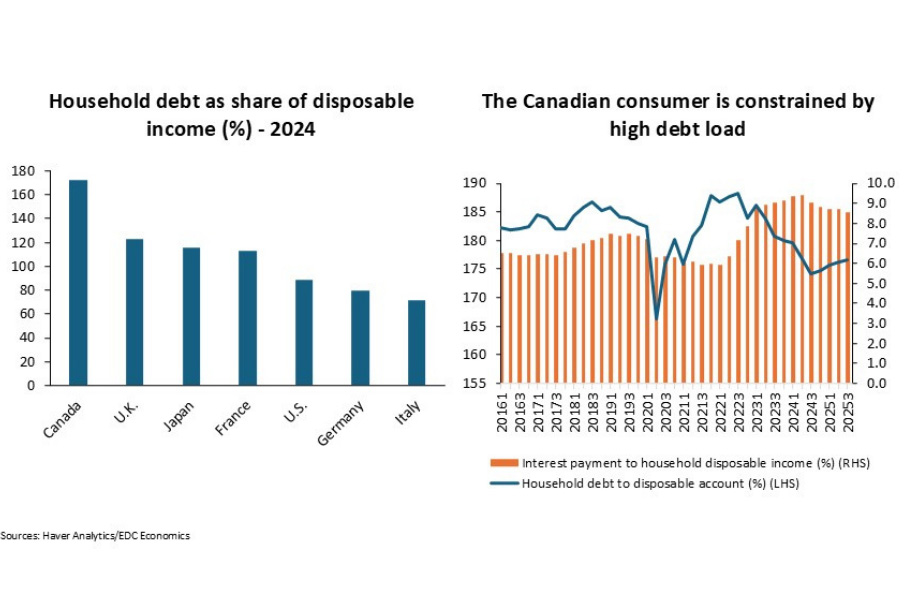
A second downside risk stems from household vulnerabilities. High costs of goods and services, elevated housing prices and economic uncertainty are the most cited factors weighing on Canadian consumers’ spending. Combined with high household debt levels, this leaves Canadian consumers vulnerable to interest rate shocks that would slow consumer spending and investment.
Canada ranks highest amongst G7 countries for household indebtedness, with households spending close to 9% of their disposable incomes on interest payment only. Higher interest rates could restrain consumption and investment, increasing recession risk.
Canada’s policy environment boasts several safeguards for banks and fiscal stabilizers (i.e., unemployment benefits) that could cushion downturns, but they only mitigate a portion of the risk. With unemployment insurance replacing, on average, about 55% of an eligible recipient’s income, a rise in potential job losses would represent a serious dent in demand. Potential contractions in business investments that arise, due to the uncertainty associated with looming trade threats, could result in enough job losses to significantly hit household consumption and the overall economy.
Another potential driver of weakening demand could be a stock market correction that wipes out household wealth. With the stock market near all-time highs, concentrated gains—particularly in technology and artificial intelligence-(AI)related equities—have raised concerns about a potential bubble. Should there be a sharp enough market correction, it would heighten recessionary pressures.
While a recession isn’t our baseline outlook, Canada’s economy remains exposed to several downside risks. The key concerns we’re watching are any combination of escalating trade tensions, sector-specific tariff shocks, or mounting consumer vulnerabilities that could tip the economy into a recession—with the potential for ripple effects exacerbating the effects.
Looking at Canada’s history of recessions reminds us that the country has weathered several downturns before. Resilience moving forward will depend primarily on proactive measures—like diversifying trade, maintaining strong financial safeguards and fostering innovation. For Canadian exporters looking to diversify, EDC can provide financing, risk mitigation and market information to help manage uncertainty and position businesses for long-term success in a rapidly evolving global economy.
With contributions from EDC’s Borys Minger, an associate quantitative analyst.