What China’s tariffs mean for Canadian canola exports
Author details
Prince Owusu
Senior Economist, Economic and Political Intelligence Centre (EPIC)
In this article:
Canada’s agriculture sector has long been exposed to tariff and non-tariff barriers, but geopolitics linked to China’s 2025 tariffs brought that vulnerability into sharp focus. After several years of easing bilateral trade tensions, sweeping tariffs and anti‑dumping duties once again disrupted exports to Canada’s third-largest trading partner, hitting volumes, prices and farm storage across the Prairies. Canadian merchandise exports to China totalled $34.9 billion in 2025, while bilateral trade reached $114 billion, underscoring the scale of the relationship and the stakes involved.
Canada is the world’s leading producer and exporter of canola (also known as rapeseed). Canola is used to make cooking oils, animal feed, biofuels, lubricants, detergents and cosmetics, and is an important cash crop for Canadian farmers. Historically, the U.S. and China have been the two largest export markets for Canadian canola products, including seeds, oils and meals.
Canola meal is a high-protein byproduct created by crushing canola seeds to extract the oil. It’s used primarily as a cost-effective, high-quality animal feed for dairy cows, poultry, swine and fish.
Canada exports more than six million tonnes of canola products to the U.S. each year and more than four million tonnes to China. These exports supply about 30% of China’s canola crushing capacity, which totals roughly 15 million tonnes
Over the last decade, geopolitical tensions have disrupted global trade, including Canadian exports. In 2019, Canadian canola exports to China were significantly impacted when China suspended the export licences of two major Canadian exporters, citing health concerns.
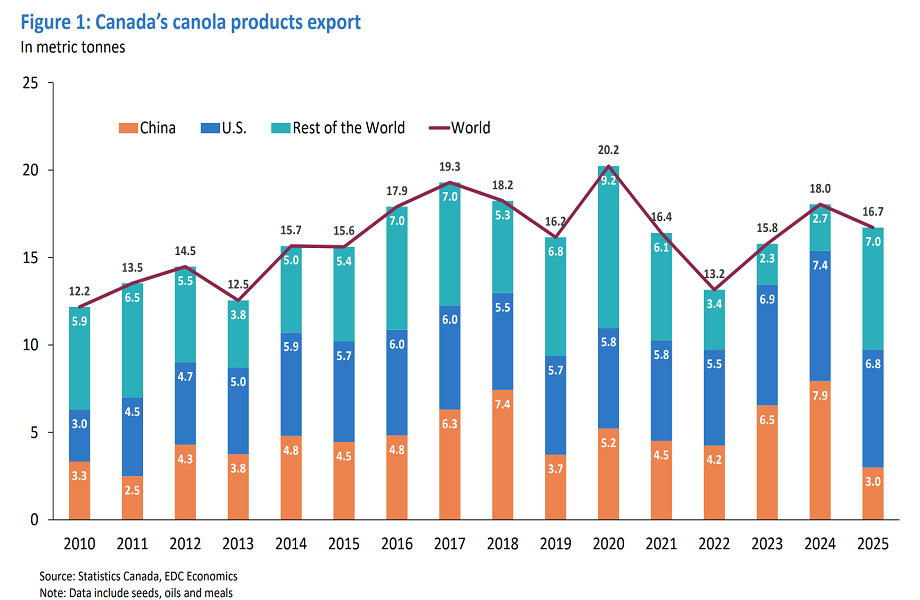
The suspension led to a sharp contraction in Canadian canola exports to China, a surplus of inventories and downward pressure on prices. The volume of China’s imports from Canada dropped to half of the previous year’s total in 2019 (see Figure 1). While Canada’s exports to China plummeted in 2019, its exports to the United States and the rest of the world rose sharply, helping to buffer the shock.
Overall, the volume of Canadian canola exports dropped 11% in 2019, with Saskatchewan’s benchmark canola price falling by nearly 10%. The COVID-19 pandemic and supply chain shocks, as well as ongoing diplomatic challenges between the countries, hit canola exports hard. But by 2023, volumes began to recover.
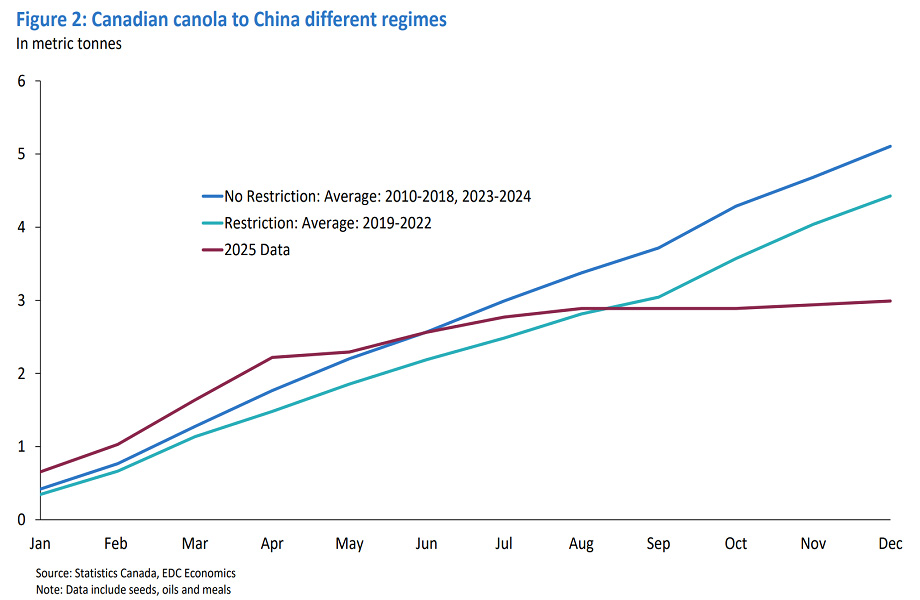
As exports began to normalize in 2023, the outlook was becoming more positive for Canada’s canola producers. The volume of canola products exported to China reached 7.9 million metric tonnes in 2024—the highest level on record (see Figure 2). But again, geopolitical concerns disrupted the progress.
In October 2024, the Canadian government imposed 100% tariffs on imports of Chinese electric vehicles (EV) to align with actions taken by former U.S. president Joe Biden’s administration. Five months later, on March 20, 2025, the Chinese government responded by applying 100% tariffs on Canadian canola oils, meals and peas, as well as a 25% tariff on pork and seafoods. Following a review, China added an additional 75.8% anti-dumping tariff on Canadian canola seeds on Aug. 14, 2025— significantly impacting canola export to there.
After the tariffs were announced, Saskatchewan’s benchmark canola price fell by almost 9%. At the same time, uncertainty about U.S. biofuel policy and new renewable diesel feedstock mandates reduced export demand.
That uncertainty also changed how U.S. buyers behaved. Many began looking for substitutes for canola, like soybeans, which were widely available because of China’s parallel retaliation against the United States.
China’s 2025 tariff on Canadian canola was more substantial than its 2019 tariffs. This caused a much larger decline in Canadian canola exports to China (see Figure 2).
Your move: How Canadian canola exports responded
In response to China’s tariffs and U.S. market challenges, Canadian exporters have increased shipments to other markets (see Rest of the world in Figure 1), including Europe, Japan and emerging Asian markets. While the volume of canola exports to China and the U.S. in 2025 declined by 62% and 9%, respectively, canola exports to the rest of the world surged by almost 161%. However, the substantial increase started from a relatively low base and wasn’t sufficient to fully offset the losses in the Chinese and U.S. markets. As a result, total export volume in 2025 registered a 7.4% contraction.
Meanwhile, China increased buying from alternative suppliers such as Australia and India. However, these suppliers didn’t fully replace Canadian volumes. As a result, China’s imports of canola products in 2025 were down to almost 50%. At the same time, a strong 2025 harvest for Canadian canola producers and tariffs constraining export flows put a strain on storage capacity.
You should also check out
Arlene Dickinson shares insights on agri-food exports, risks and growth opportunities in Indo-Pacific markets.
Canadian Prime Minister Mark Carney’s trip to China in early 2026 was an opportunity for Canada and China to form a new strategic partnership and reset the trade relationships. During the visit, the countries reached an agreement that Canada would adjust tariffs on Chinese EVs and China would lower barriers for Canadian agricultural exports. As of March 1, 2026, China cut tariffs on Canadian canola seed to a combined rate of approximately 15% and committed to exempting Canadian canola meal, lobsters, crabs and peas from anti-discrimination tariffs in 2026.
Export Development Canada (EDC) Global Trade director Jay Albers says the sector is better positioned to respond as conditions improve.
“Even after a volatile year, exporters that adapted after 2019, by diversifying markets and adding value at home, are better positioned to respond as trade barriers ease. That resilience is becoming a competitive advantage,” Albers says.
Besides improved relations with China, biofuel policy changes in the U.S. also present opportunities for Canada. The One Big Beautiful Bill Act (OBBBA), which outlines U.S. President Donald Trump’s tax and spending plan, includes changes to U.S. clean fuel tax credits that would restore Canadian producers’ eligibility and remove carbon penalties. If finalized, the credits would apply retroactively from Jan. 1, 2025, through 2029.
The updated rules would also reopen the U.S. biodiesel and renewable diesel market to non-U.S. feedstocks, while still requiring eligible feedstocks to be grown or produced in North America. This explicitly includes Canadian canola and excludes overseas alternatives such as imported used-cooking oil and tallow.
Overall, the policy change should improve the medium-term outlook and increase demand for Canadian canola, soybean and corn.
Key takeaways
- In 2025, China’s high tariffs and anti-dumping duties sharply reduced Canadian canola exports and caused prices to drop by nearly 9%.
- In response, Canadian canola exporters redirected shipments to Europe, Japan and emerging Asian markets. Exports to China and the United States declined sharply, but volumes sent to alternative destinations surged by nearly 161%. This surge, however, wasn’t enough to fully offset the impacts—resulting in 2025 total exports volume falling by 7.4%.
- A strategic partnership agreement reached in early 2026 between Canada and China will help address trade issues, improving market access for Canadian canola. In the U.S., an updated biofuels policy and renewed clean fuel tax credit for North American feedstock will further expand canola’s market opportunities.
Tariffs and trade policy uncertainty have repeatedly exposed the vulnerability of Canada’s canola sector to geopolitical shocks, suppressing prices and straining farm storage. However, accelerated market diversification and growing global demand have softened the blow.
With the Canada-China agreement in place and alternative markets expanding, Canadian producers are entering the 2026 season with cautious optimism—and a clearer objective: Building long-term resilience in an increasingly politicized global trade environment.
Connect with EDC
EDC helps Canadian companies navigate complex markets, including China. Since 1979, EDC has supported Canadian exporters and investors in Greater China, helping companies enter the market, expand their footprint and manage risk in an evolving trade environment.
With representations in Shanghai and Beijing, our in-market teams provide on-the-ground insights, sector knowledge, market intelligence and connections to help Canadian exporters—including agri-food producers—navigate China’s business landscape with greater confidence.
If you’re exploring opportunities in China or looking to strengthen your export diversification strategy, connect with EDC to get started.