Critical minerals at a turning point: Supply, processing and AI-driven demand
Author details
Karicia Quiroz
Economist | Country & Sector Intelligence
In this article:
The global critical minerals landscape is shifting. The focus is moving away from resource potential toward whether supply can be delivered reliably and at scale, including during disruption. Three themes illustrate this shift:
1. The challenge is no longer geology, but getting projects built and operating;
2. Major bottlenecks sit in processing; and
3. Artificial intelligence (AI) is boosting demand for critical minerals while also reshaping how mines operate.
These themes were evident at the 2026 Prospectors & Developers Association of Canada (PDAC) convention, which brought together global mining companies, investors, governments and industry experts.
A consistent message at PDAC was that having minerals in the ground is no longer enough. Governments, investors and end-users are increasingly focused on whether supply can be delivered reliably through disruptions—not simply at the lowest cost. Supply chain security is now top of mind.
For many governments, critical minerals have shifted from a purely economic consideration to a national security priority, given their role in defence systems, energy infrastructure and advanced technologies. This has helped create a form of “insurance demand,” where buyers are willing to pay a premium for secure supply as market concentration and geopolitical risks become more visible.
These priorities reflect underlying supply constraints. According to S&P Global, the average time required to bring a new mine into production stretched to nearly 18 years for projects coming online between 2020 and 2024—almost three times longer than in the 1990s. As a result, exploration capital is increasingly directed toward lower-risk opportunities near existing mine sites where geology, permitting and infrastructure are already established—rather than frontier discoveries.
Mine development remains long and capital-intensive, shaped by permitting timelines, infrastructure availability (including power), financing risk and community engagement. Even with strong geology, short- to medium-term supply growth now depends largely on execution.
You should also check out
EDC helps Canada lead in critical minerals with financing, partnerships and sustainable mining.
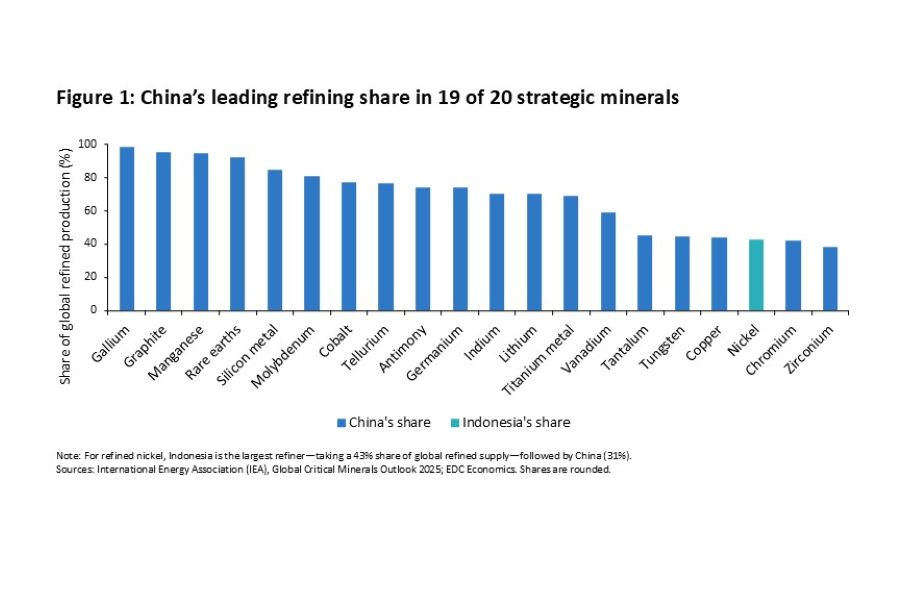
The supply security lens intersects directly with geopolitics at the processing and refining stage, where capacity is more concentrated—and harder to replicate—than mining. The International Energy Agency (IEA) estimates that China is the leading refiner for 19 of 20 strategic minerals, with an average market share of 70% (Figure 1).
Export controls have turned these concentration risks into real constraints. Decades of underinvestment allowed processing capacity to concentrate in a small number of jurisdictions, increasing exposure to supply disruptions, price volatility and procurement risk across sectors such as clean energy, automotive manufacturing, defence and advanced electronics. The IEA estimates that more than half of the 20 strategic minerals are subject to some form of export control.
Rare earths elements (REEs): China controls more than 90% of global separation and refining capacity, and permanent magnet manufacturing—the most important downstream use of rare earths. Supply bottlenecks are expected to persist through 2026, especially for heavy REEs used in high-performance magnets. The key chokepoint in the supply chain is processing—specifically the ability to refine materials to the quality required for advanced magnet applications. As this capability remains highly concentrated in China, countries that rely on processed rare earths remain exposed to supply disruptions—a vulnerability highlighted by China’s export controls introduced in 2025 and expanded into early 2026.
Dominance at the processing stage also affects pricing and availability, weakening the business case for alternative capacity and contributing to policy-led market fragmentation. Governments are increasingly using tools such as public financing, stockpiling and long-term offtake agreements to anchor supply within aligned jurisdictions, even where lower-cost supply exists elsewhere.
AI is emerging as a new source of metals demand, adding to pressures created by electrification and digital infrastructure. Most AI activity takes place in large data centres, which require substantial amounts of electricity. The IEA estimates that data centres accounted for 1.5% of global electricity demand in 2024, a share expected to double by 2030.
This expansion is driving investment in power generation, transmission and grid upgrades—all of which rely heavily on metals. This includes aluminum for cooling systems, REEs for data storage and high-performance magnets and copper, which plays a central role across this infrastructure. Copper is used in power cables, transformers, cooling systems and internal wiring. BloombergNEF estimates that AI data centres use an average 27 tonnes of copper per megawatt of capacity, with global data centre copper demand averaging around 400,000 tonnes per year over the coming decade.
On the supply side, AI is also reshaping how mines operate. PDAC discussions highlighted its use in identifying exploration targets, improving recoveries at operating mines and anticipating equipment issues before failures occur. These gains depend on strong data foundations. While AI doesn’t eliminate core challenges such as permitting, processing capacity, or power availability, it can improve efficiency and productivity, helping miners extract more value from existing assets.
Implications for Canada’s critical minerals positioning
Taken together, these trends—security-driven demand, processing bottlenecks and rising metals demand linked to AI—frame both the opportunities and constraints shaping Canada’s critical minerals positioning.
Canada’s current export strengths remain concentrated in a small group of commodities, including aluminum, copper, potash, nickel and uranium, where large-scale production and supporting infrastructure are already established. By contrast, several policy priority minerals—such as lithium, cobalt, graphite and REEs—remain at an earlier stage from an export perspective.
A persistent challenge has been attracting risk-tolerant, long-term capital, particularly for capital intensive processing and refining. According to RBC, roughly 10% of mining capital raised in Canada over the past 25 years has flowed to critical minerals, reinforcing a long-standing “mine and ship” model where higher-value processing has largely taken place elsewhere.
More recently, investment momentum has begun to improve. Nearly half of all active mining proposals in Canada for 2024-2034 are now tied to critical minerals, representing more than $72 billion in potential investment. Recent federal measures focused on infrastructure, financing and processing are helping shift the focus from strategy to project execution.
Canada’s competitiveness is, therefore, increasingly execution-dependent. Access to low-emissions power and comparatively strong environmental and social standards are often cited as advantages as governments and end-users place greater emphasis on how critical minerals are produced. Converting these strengths into a stronger export position will depend on continued progress in permitting, infrastructure buildout (including power), integration into allied supply chains and the expansion of domestic processing and refining capacity.
Against this backdrop, Export Development Canada (EDC) supports Canada’s critical minerals sector by helping companies manage risk, access capital and integrate into allied supply chains as global demand and supply security pressures intensify.
New to EDC? Visit Export Help Hub to connect with a trade advisor and learn how we can support your export strategy. Already an EDC customer? Contact your relationship manager to discuss how current global developments may affect your business, or call 1-800-229-0575.