MyEDC account
Manage your finance and insurance services. Get access to export tools and expert insights.
Solutions
By product
By product
By product
By product
Insurance
Get short-term coverage for occasional exports
Maintain ongoing coverage for active exporters
See how portfolio credit insurance helped this Canadian innovator expand.
Guarantees
Increase borrowing power for exports
Free up cash tied to contracts
Protect profits from exchange risk
Unlock more working capital
Find out how access to working capital fueled their expansion.
Loans
Secure a loan for global expansion
Get financing for international customers
Access funding for capital-intensive projects
Find out how direct lending helped this snack brand go global.
Learn how a Canadian tech firm turns sustainability into global opportunity.
Investments
Get equity capital for strategic growth
By industry
Find opportunities in agri-food trade
Expand your cleantech business
Grow your defence exports
Explore solutions for domestic oil and gas
Featured
Discover the top cleantech trends influencing exporters in 2026
Build relationships with global buyers to help grow your international business.
Resources
Popular topics
Explore strategies to enter new markets
Understand trade tariffs and how to manage their impact
Learn ways to protect your business from uncertainty
Build stronger supply chains for reliable operation
Access tools and insights for agri-food exporters
Find market intelligence for mining and metals exporters
Get insights to drive sustainable innovation
Explore resources for infrastructure growth
Export stage
Discover practical tools for first-time exporters
Unlock strategies to manage risk and boost growth
Leverage insights and connections to scale worldwide
Learn how pricing strategies help you enter new markets, manage risk and attract customers.
Get expert insights and the latest economic trends to help guide your export strategy.
Trade intelligence
Track trade trends in Asia-Pacific
Uncover European market opportunities
Access insights on U.S. trade
Browse countries and markets
Get expert analysis on markets and trends
Discover stories shaping global trade
See what’s ahead for the world economy
Monitor shifting global market risks
Read exporters’ perspectives on global trade
Knowledge centre
Get answers to your export questions
Research foreign companies before doing business
Find trusted freight forwarders
Gain export skills with online courses
Discover resources for smarter exporting
Get insights and practical advice from leading experts
Listen to global trade stories
Learn how exporters are thriving worldwide
Explore export challenges and EDC solutions
About
Discover our story
See how we help exporters
Explore the companies we serve
Learn about our commitment to ESG
Understand our governance framework
See the results of our commitments
MyEDC account
Manage your finance and insurance services. Get access to export tools and expert insights.
Economist and country risk analyst, Economic Political Intelligence Centre
In this article:
For much of the 21st century, Germany was widely regarded as the key driver of the European economy. Its strength was built on a powerful mix of high-end engineering, a highly skilled labour force and a global reputation for quality.
But that model was shaken by the COVID-19 pandemic and Russia’s full-scale invasion of Ukraine. Germany is now facing a difficult period of economic adjustment.
“Germany’s economy is undergoing a structural shift, but its industrial depth and policy response position it to adapt over time,” says Klaus Houben, Export Development Canada’s (EDC) business development director for Europe.
Germany began importing gas from the Soviet Union in the 1970s, a relationship that later continued with Russia for nearly 50 years. Over time, access to reliable, low-cost gas became a major advantage for German industry, helping energy-intensive sectors, like chemicals and steel, stay competitive globally.
When Russia’s full-scale invasion of Ukraine began in February 2022, the European Union (EU) imposed sanctions that led to Russia cutting off all natural gas supplies to Germany. The impact was severe: Germany’s wholesale natural gas prices skyrocketed from about $30 to $60 per megawatt-hour (MWh) in 2021, to more than $400 per MWh in mid-2022, before easing later that year.
Germany quickly found new gas supplies and built liquefied natural gas (LNG) import capacity to avoid shortages. Even so, energy costs are significantly higher than before the war and German industry has been hit hard.
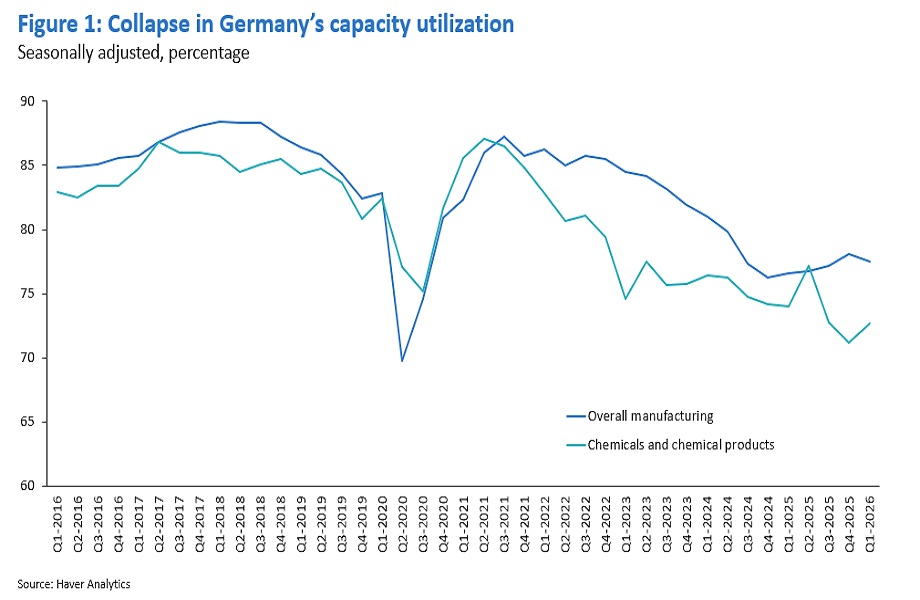
The chemical industry, a cornerstone of the economy, saw its capacity utilization fall to just 73% in 2025, a considerable drop from the average of 84% recorded between 2014 and 2019 (see Figure 1).
Despite ongoing conflict in the Middle East and elevated energy prices, Germany is better positioned than in 2022 to manage a gas supply shock. It has reduced dependence on a single pipeline route and expanded LNG capacity. The main vulnerability now is price, as global LNG disruptions quickly feed into European benchmarks.
What shifting global conditions, rising costs and uneven growth mean for your export decisions in 2026.
Even before higher energy costs, the pandemic exposed vulnerabilities in Germany’s export-driven manufacturing model.
Just-in-time supply chains—long valued for efficiency—became points of weakness as factories and suppliers shut down. The automotive sector, which accounts for about 17% of German exports, was hit particularly hard, as automakers relied heavily on global suppliers for semiconductors and other components. Production stalled and companies struggled to meet demand.
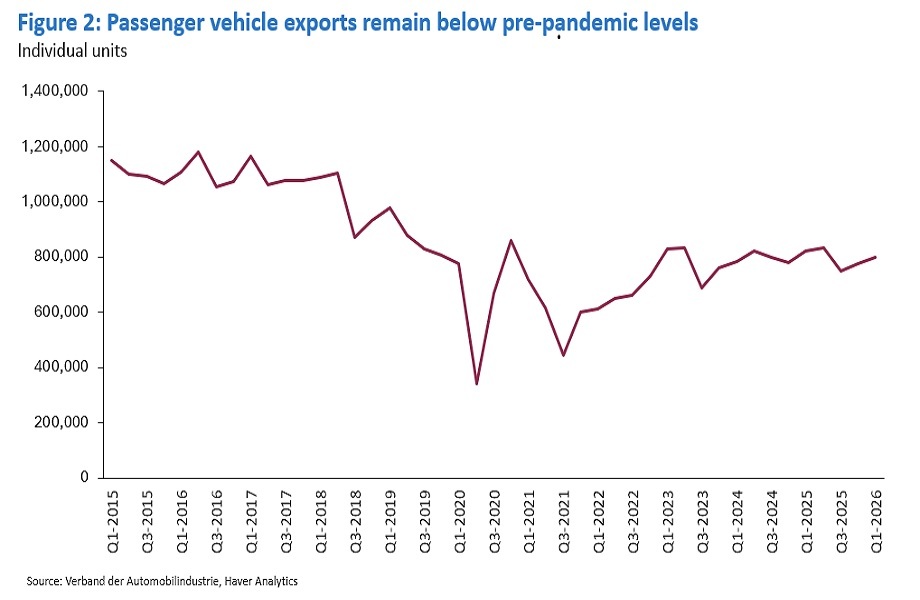
The recovery has been uneven. Vehicle production rose slightly to 4.15 million passenger vehicles in 2025, from 4.07 million in 2024, but remained about 11% below pre-pandemic levels. Exports also lagged, down 9% from 2019 (see Figure 2).
Employment has declined as well. The German automotive sector employed about 732,000 people in 2025—down 12% from 2019—as it adjusts to electrification and intensifying competition.
As a result, companies are reworking supply chains by diversifying suppliers, increasing inventories and reducing reliance on single regions.
A third major pillar of Germany’s economic success in the 2000s and 2010s was strong demand from China. As China’s economy expanded, exports of German machinery, chemicals and premium vehicles surged.
That dynamic has shifted dramatically. China is now a major global competitor—not just a customer—particularly in electric vehicles. Chinese brands are gaining global market share and eroding the dominance German automakers once held.
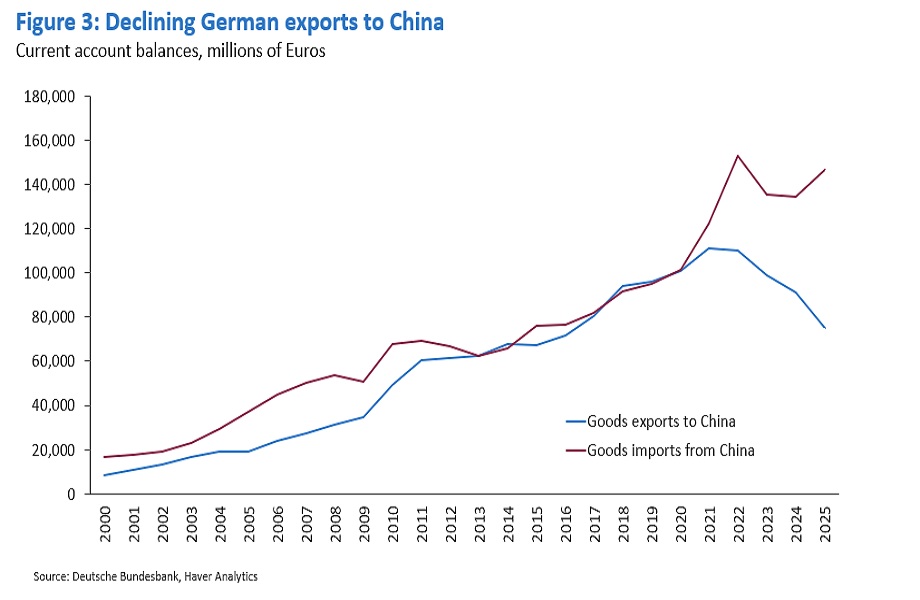
China remains essential to German trade, but the balance has changed. Germany now imports more from China than it exports. After briefly falling to second place in 2024, China again became Germany’s largest trading partner from January to September 2025, with about $280 billion in two-way trade—slightly ahead of the U.S. at roughly $277 billion.
Over the same period, German exports to China fell 12.3%, while German imports from China rose 8.5%, widening Germany’s trade deficit (see Figure 3).
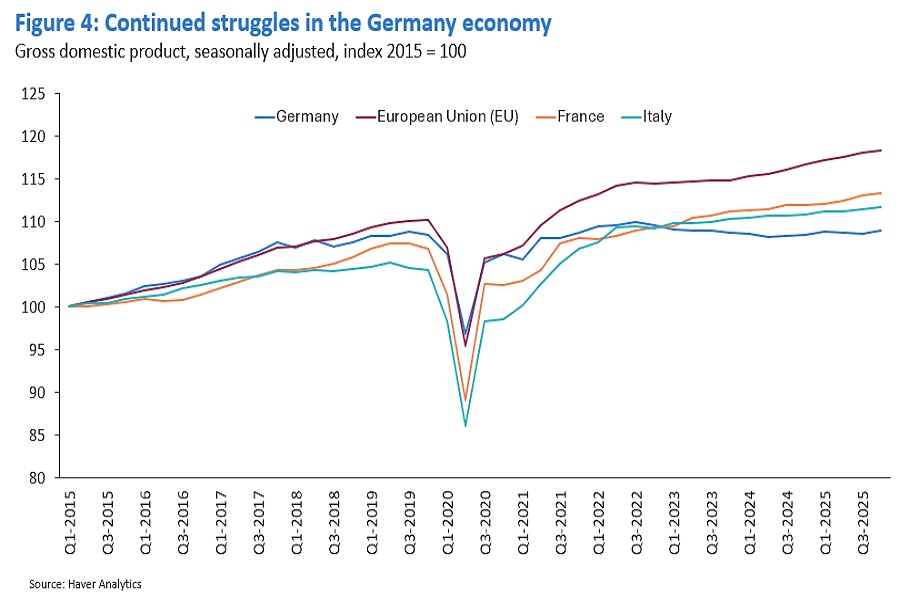
These pressures have led to stagnant growth. Germany’s economy now lags behind European peers (see Figure 4), with real gross domestic product (GDP) in 2024 roughly at 2019 levels and only marginal growth (0.2%) in 2025.
Since 2020, Germany has struggled to adapt to a world where cheap energy and open global trade are no longer guaranteed.
Germany remains a key European partner for Canada. In 2024, Canada exported about $6.9 billion—primarily energy and industrial inputs—to Germany, according to Statistics Canada. Imports from Germany totalled $23.6 billion, led by cars and pharmaceuticals.
Investment ties are also significant: In 2024, German foreign direct investment (FDI) in Canada reached $40.3 billion, compared with $16.2 billion in Canadian direct investment abroad (CDIA) in Germany.
Canada and Germany benefit from strong trade ties under the Canada-European Union Comprehensive Economic and Trade Agreement (CETA), which reduces tariffs and improves market access for Canadian exporters.
Germany’s transition is creating new opportunities for Canadian firms:
Explore EDC’s European market intelligence guide for insights on key markets across the region, including Germany.
The German government has committed to a Zeitenwende—a turning point in security and economic policy—backed by major investment in renewable energy and industrial transformation. The goal is to transform Germany into a leader in climate-neutral manufacturing. If successful, this could provide a new green foundation for German exports.
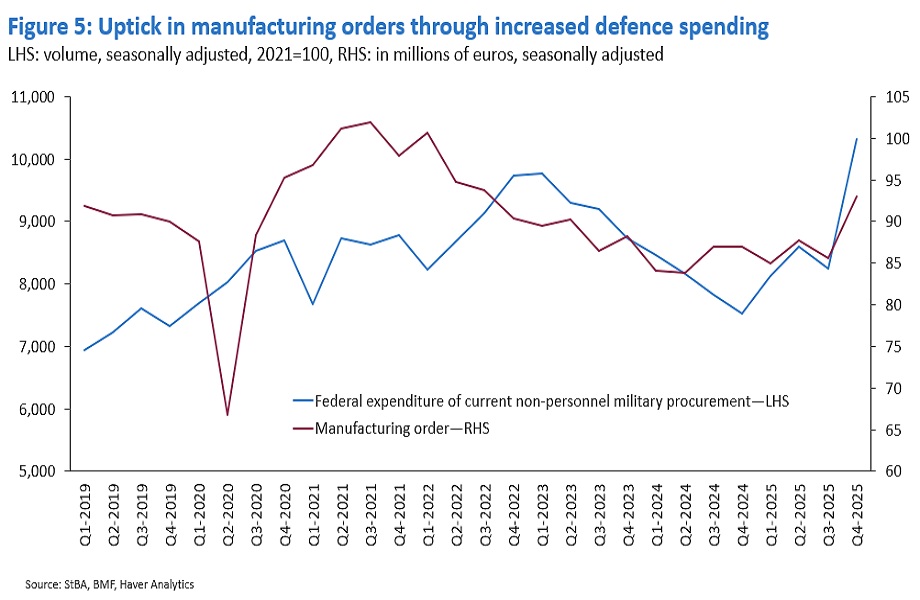
Since March 2025, Germany has introduced a $750-billion multi-year infrastructure fund to boost spending on transport, digital systems, energy and defence. If implemented effectively, it could strengthen Germany’s long-term growth capacity. Early signs are emerging, including an uptick in orders (see Figure 5).
While a positive development, Germany’s economy remains in transition. The previous reliance on low-cost Russian gas and strong demand from China are gone. The economy is shifting toward a more diversified, digital and energy efficient model that will take time to consolidate.
Energy costs remain elevated, demographic pressures are mounting and competition from China is intensifying across key sectors. Yet, Germany’s commitment to renewable energy and technological upgrading signals a clear direction.
For Canadian firms offering clean technology, critical minerals, digital solutions and supply chain resilience, the opportunity is substantial. There’s also an opportunity to deepen partnerships with German companies seeking to diversify beyond China—particularly in North America. By positioning Canadian capabilities within Germany’s evolving industrial strategy, Canada can help strengthen commercial ties, while enabling Germany’s shift toward a more sustainable and resilient economic model.
If you’re exploring opportunities in Germany or looking to strengthen your export diversification strategy, connect with EDC to get started.
Economist and country risk analyst, Economic Political Intelligence Centre
Learn about key sectors, market trends, and how EDC supports Canadian businesses expanding to Europe.
Canada’s critical minerals strengthen Germany’s energy transition and industrial resilience.
Explore export opportunities in Germany’s green, digital, defence and agri-food sectors.
Energy shocks and geopolitical risk are testing global resilience. What it means for growth, trade and Canadian exporters—and how EDC’s Global Economic Outlook can inform market planning.
EDC’s interactive tool offers economic insights on Canada’s Top 75 trading partners.