Brazil’s agricultural boom: What it means for Canadian business
Author details
Daniel Benatuil
Sr. country risk analyst | Economic and Political Intelligence Center
In this article:
Brazil’s recent bumper harvests have consistently lifted both output and growth expectations. For Canadian businesses, Brazil’s scale is great news, especially since the country is reshaping global agricultural markets at a time when diversification, food security and supply resilience are top of mind.
Brazil’s US$2.3-trillion economy is the world’s 10th largest and its agriculture sector alone ranks as Latin America’s seventh largest economy. Brazil is already Canada’s second largest destination in the region for both goods exports and direct investment. Although similar natural resources limit some product-level trade, the relationship is supported by strong Canadian exports of fertilizers, machinery and equipment, as well as growing opportunities for Canadian expertise in strategic growth sectors such as agriculture and agri-food.
Canada’s commercial relationship with Brazil is longstanding, with Canadian companies active in the market for decades, particularly in sectors such as agriculture, agri-food inputs, mining, infrastructure and financial services. Brazil is a priority market for Export Development Canada (EDC), which supports Canadian exporters and investors with market intelligence, local expertise and on-the-ground presence, including guidance on navigating business culture and operating practices across Latin America. Two-way merchandise trade between Canada and Brazil reached $14.7 billion in 2025, a 15.7% increase from the previous year.
Since the early 2000s, the sector has evolved into a reliable engine of growth and revenue generation, accounting for 8% of gross domestic product (GDP), 16% of employment and 40% of exports. When the broader agri-food value chain is included, that contribution reaches 22% of GDP.
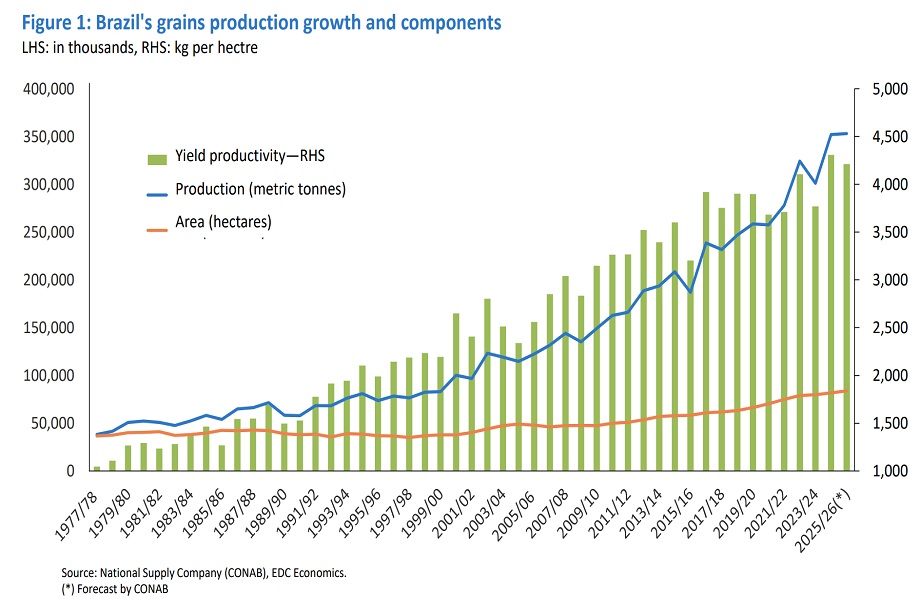
The scale of Brazil’s transformation into a leading agricultural producer has been exponential. Crop production volumes have more than quadrupled over the past 25 years, driven by both a doubling of planted area and strong yield gains. But what’s Brazil’s secret sauce? And how long can it sustain this bonanza?
In the early 2000s, Brazil pivoted away from traditional tropical exports such as coffee and sugar toward bulk commodities, notably soy and corn. Growth accelerated rapidly, fuelled by China’s surging demand during the commodities super-cycle, from 2000 to 2014.
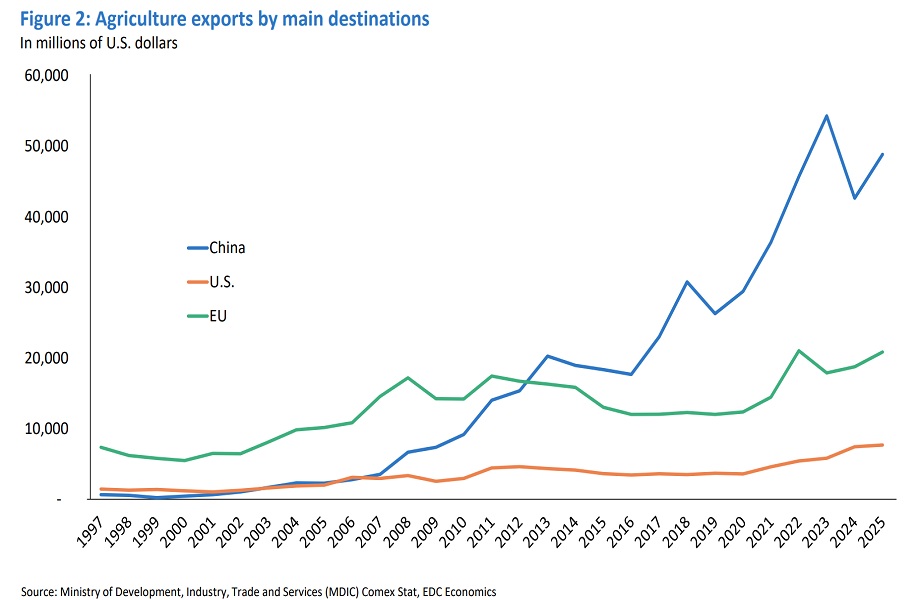
By 2013, Brazil had overtaken the United States as the world’s top soybean exporter. More recently, rising U.S.-China trade tensions further diverted Chinese demand toward Brazilian products. Soybeans are now Brazil’s agricultural crown jewel by export value, followed by raw sugar, coffee, soybean meal and corn.
China remains, by far, the largest export destination, accounting for nearly three-quarters of Brazil’s soybean exports. Overall, Brazil’s top agricultural export markets are China (35%), the European Union (14%) and the U.S. (5%). Meanwhile, faster shipment growth to Africa, Asia and the Middle East points to gradual export diversification, partly driven by global food security concerns.
Why Brazil’s agricultural boom is structural, not cyclical
Brazil’s agricultural success didn’t happen by chance. Unlike mature producers, where output growth depends largely on incremental productivity gains, Brazil sits in a development “sweet spot” where cropland expansion and productivity growth reinforce each other.
A critical driver has been long-term investment in research and technology. The creation of the state-owned Brazilian Agricultural Research Corporation (or Embrapa, also known as Brazil’s farming “Silicon Valley”) in the 1970s laid the groundwork for major advances in crop science and tropical agriculture. These innovations enabled the conversion of degraded pasture, particularly in the Cerrado region, into high-yield farmland, unlocking millions of hectares for large-scale production.
While deforestation remains a paramount sustainability concern, Embrapa estimates that up to 28 million hectares of pasture could still be sustainably recovered, equivalent to a 35% increase in total planted area, compared to the 2022-2023 crop year.
Brazil’s long growing season also allows for crop intensification. Whereas producers in temperate climates often rely on single-crop cycles, Brazil can grow two crops per year on the same land. Since the early 2000s, the second corn crop, known as safrinha, has been a major contributor to Brazil’s rise as a global producer, with further potential through intensification.
Policy and institutional frameworks have also played a key role. Brazil operates with relatively low trade protection and limited price distortions, while access to finance and insurance is increasingly tied to environmental compliance. Market-oriented policies, combined with heavy public investment in research and technology diffusion, have boosted competitiveness and attracted private capital.
Advances in biotechnology—many led by Embrapa—have supported widespread adoption of genetically engineered crops, helping lift yields by 70% in two decades. Brazil’s biofuels mandate adds another durable growth pillar. The 2024 Fuel of the Future Law increases mandatory blending requirements, supporting ethanol and biodiesel production and boosting demand for sugarcane, corn and soy, reinforcing farm income and investment.
You should also check out
EDC interactive tool delivers economic insights on Canada’s Top 75 trading partners.
Agriculture’s rapid expansion has generated broader economic spillovers. Investment has flowed into processing activities such as crushing capacity and ethanol production, contributing to the development of agro-industrial zones (central locations for large-scale processing).
At the same time, large-scale investment in transportation and logistics infrastructure is expanding road, rail, port and barge corridor capacity to move ever-larger crop volumes. A surge in concessions and public-private partnerships, supported by strategies such as the National Logistics Plan 2035, aims to turn long-standing bottlenecks into a competitive advantage.
Simply put, Brazil still has considerable headroom. The country is expected to bring roughly 20 million hectares into production by 2031, one of the fastest area expansion rates globally and roughly equivalent to France’s total arable land area.
This expansion won’t be without challenges. Remote degraded pastures require significant investment in land conversion and rural logistics infrastructure. Climate change also presents risks, with research suggesting that changing conditions could weigh on projected land values and the financial viability of new conversion efforts.
Yield growth will remain a key driver. While Brazil’s soybean yields are already world-class, yields for many other major field crops still lag those of global competitors. Yield gains will therefore remain a key structural driver of growth even as the rate of land expansion will eventually moderate. Fortunately, this maturation shift will not arrive any time soon. Official projections estimate Brazilian grain production will grow 27% through the 2033-2034 harvest compared to 2023-2024 levels, supported by both continued land expansion and further yield gains.
Near-term risks facing Brazil’s agriculture sector
Despite strong long-term fundamentals, near-term pressures are emerging. High interest rates, tighter credit conditions and elevated input costs have squeezed farm margins and contributed to rising bankruptcies.
Brazil’s heavy reliance on imported fertilizers remains a key vulnerability to geopolitical shocks, as ongoing conflicts have highlighted through price spikes and supply disruptions. Fiscal constraints also matter. Rising public debt could limit the government’s ability to expand funding for key support programs such as the Agricultural Plan (Plano Safra), Brazil’s main agricultural financing tool. Together, these factors could lead to short-term volatility in planting decisions and output, while stricter environmental compliance requirements continue to add regulatory and cost pressures. The foundations for long-term growth remain strong, but funding and structural constraints will shape the pace.
Why Brazil’s agriculture boom matters for Canada
Brazil’s growing influence in global agricultural markets has direct consequences for Canadian farmers and suppliers.
“Brazil’s farm boom opens the door to a wide range of opportunities for Canadian exporters,” says Ashley Kanary, EDC’s director of agri-food strategy. “Beyond wheat, pulses and specialty foods, demand is growing for fertilizers and soil health inputs, feed ingredients and additives, and ag-tech solutions tied to sustainability and yield gains—areas where Canadian expertise is highly competitive.”
From a market perspective, Justin Shepherd, senior economist at Farm Credit Canada, notes that “Canadian farmers closely monitor Brazilian grain production. Brazil’s harvest and export activities typically peak just before North American planting season, influencing U.S. futures prices. Consequently, spring planting decisions in Canada and the U.S. are affected by Brazil’s agricultural outcomes.”
From a competitive standpoint, Brazil’s low-cost production intensifies pressure on Canadian exporters in Asia-Pacific and the Middle East, while the European Union-Mercosur Partnership Agreement and Interim Trade Agreement further improves Brazil’s access to European markets. Mercosur is the South American trade bloc that includes Argentina, Bolivia, Paraguay and Uruguay. Even so, Brazil’s agricultural expansion is creating new areas of strategic alignment with Canada.
Fernanda Custodio, EDC’s business development director for Brazil and the Southern Cone, says Brazil and Canada show strong complementarities in natural resources, particularly agribusiness, where both countries are leading global food producers.
“In Brazil, rising investment—largely driven by the private sector—is accelerating the country’s transition toward greater efficiency, productivity and competitiveness in agricultural goods and services. This shift is creating a strong pipeline of market-entry and expansion opportunities for Canadian companies, especially those offering advanced ag-tech solutions, digital tools and other high-value technologies that support the modernization of agricultural systems and supply chains,” Custodio says.
For Canadian firms, this alignment is translating into concrete areas of engagement. Brazil’s vast agriculture sector offers scope for Canadian agri-businesses, logistics firms, fertilizer suppliers and ag-tech companies—particularly in precision agriculture, sustainability solutions, digital crop monitoring, inputs and transport infrastructure.
Brazil’s agricultural boom is reshaping global markets, creating both competitive pressures and new opportunities for Canada. The scope to deepen the bilateral partnership is significant and could be further strengthened by reinvigorated Canada-Mercosur trade negotiations. With a strong market presence and a suite of financial and knowledge solutions, EDC is well-positioned to support Canadian companies looking to grow in Brazil’s dynamic agriculture sector.
New to EDC? Visit Export Help Hub to connect with a trade advisor and learn how we can support your export strategy. Already an EDC customer? Contact your relationship manager to discuss how current global developments may affect your business, or call 1-800-229-0575.