How Canadian exporters can supply the AI data centre boom
Author details
Patrick Michetti
Ecosystem Lead for Advanced Manufacturing
In this article:
- The global data centre supply chain: Where the export opportunities are
- Where suppliers win: Infrastructure, power and cooling in AI data centres
- Key challenges for Canadian companies supplying global data centres
- Why Canadian exporters are competitive in global data centre projects
- How EDC helps Canadian data centre suppliers export and scale
- Why Canadian companies should consider competing
- Best export markets for Canadian data centre suppliers
Artificial intelligence (AI) is poised to be one of the most impactful technologies in modern history. Its rapid growth is fuelling a surge in global demand for data centres, including across Asia-Pacific, Europe and the United States.
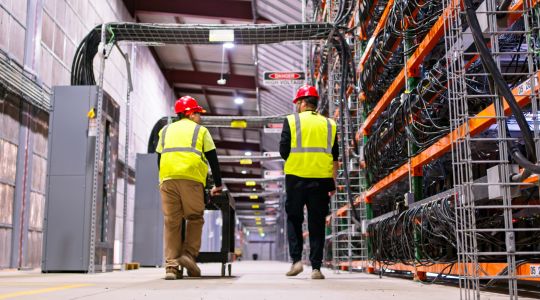
For many Canadian medium‑sized companies, this surge creates major opportunities to supply the specialized components, systems and services needed to build and operate data centres. But projects are scaling faster than supply chains can respond. Canadian exporters with niche expertise, proven reliability and the ability to deliver into complex, international projects are well positioned to compete.
These high value supply chain opportunities span multiple sectors, including infrastructure, energy and digital services. Export Development Canada (EDC) can support exporters’ success by helping with everything from financing to making business connections.
The AI data centre value chain opportunity currently stands at $7 trillion, with a wide range of sectors taking part, including health care, automotive, financial services, mining, industrial automation, retail, agriculture and energy. In addition to the global demand, there’s also increased pressure to build domestic AI data centres because governments want their own sovereign centres to be in control of their data.
Current demand for data centres that support AI far exceeds supply. Hyperscalers (large-scale cloud service providers) and co-locators (facilities that lease physical space, power, cooling and network connectivity to other companies), in particular, require substantial upfront investment in land, power, infrastructure, cooling systems, networking equipment and security. Canadian entrepreneurs are well positioned to join the supply chains of these lucrative bricks-and-mortar projects.
For a 100-megawatt facility, the typical cost breakdown is as follows:
- Information technology (IT) equipment: 60-65%
- Infrastructure: 25-30%
- Physical building: 5-10%
While IT equipment dominates data centre costs, a substantial share of spending flows through infrastructure, power, cooling and building systems—where suppliers and service providers play a critical role.
For medium‑sized exporters, these categories often represent the most accessible opportunities: Supplying specialized components and services through global data centre advisory firms (top-rated brokers) and engineering, procurement and construction (EPC) firms.
Key data centre requirements include:
- Power: Surging electricity requirements are now eclipsing 110 megawatts.
- Cooling: They require complex liquid cooling systems to solve their high heat outputs.
- Sustainability: Builders need to balance the high-density power needs with sustainability and build modular data centres close to green power sources.
- Networking and software: Encryption, isolation, ease of deployment and management of workloads are all necessary, as are non-blocking and low-latency architecture. A non‑blocking and low‑latency data centre ensures data can flow at full speed with no bottlenecks or delays, critical for AI and real‑time digital services.
- Supply chain: There are long lead times, making relationships matter more than ever.
- Densification: The surge in demand creates high-performance compute and space crunches, leading to modular data centre momentum.
For suppliers, these capital-intensive data centres are typically long-term, highly structured and globally sourced. Contractors favour companies that can meet demanding technical, financial and delivery requirements across borders.
What global data centre developers look for in suppliers:
- Compete on reliability, not just price: Data centre developers favour suppliers who can deliver on time despite long lead times. These suppliers must also meet strict performance and uptime requirements and support multi‑year, multi‑site rollouts. Canada’s reputation for quality and experience is a key differentiator in this supply chain.
- Overcome financial and bonding barriers: The financial structure of data centre projects is a major hurdle. These projects require large upfront capital requirements, long payment cycles and buyer‑mandated bonds and guarantees.
- Build cross‑border delivery capability: Data centre supply chains are global by design, often requiring suppliers to operate across multiple jurisdictions, navigate different regulatory and procurement regimes and meet local content or compliance requirements. Suppliers who succeed tend to partner with local contractors or integrators, establish a regional presence near key markets, align early with developers and EPC firms.
- Address risk, regulation and sustainability head on: Data centres sit at the intersection of data sovereignty, cybersecurity, energy intensity and water use, as well as geopolitical and regulatory risk. These factors increasingly shape supplier selection and site decisions. Winning suppliers integrate environmental, social and governance (ESG) discipline and energy efficiency into their value proposition, demonstrate compliance readiness (security, data, environmental) and offer solutions aligned with sustainability targets.
- Position themselves in the right place of the value chain: Canada has strong capabilities across the data centre value chain and understanding where you fit—and how your offering supports hyperscalers, co-locators, or edge deployments—is critical to competing effectively.
Canadian companies of all kinds, including pension and investment funds, are working in this space. Canada has expertise in other sectors also in high demand, including design. Strength lies in specialized, high-value inputs and services in the supply chain that are increasingly critical as data centres become larger, denser, greener and more regulated.
You should also check out

Canada excels in R&D and media services, but IP and infrastructure gaps constrain digital trade.
Where Canadian exporters fit in the global data centre value chain
Most Canadian exporters enter global data centre projects as Tier 2 or Tier 3 suppliers—selling through engineering firms, original equipment manufacturers (OEMs), system integrators, or construction contractors—rather than directly to operators. This is often the most realistic and scalable path for companies, particularly in areas where buyers value specialization, quality and delivery certainty over scale alone.
Canadian firms are well positioned to contribute at multiple stages of the data centre lifecycle, including:
- early‑stage design and engineering;
- component and systems supply during construction; and
- digital, energy and efficiency solutions once facilities are operational.
As data centres become larger, denser and more energy‑intensive, demand is increasing for suppliers who can solve complex technical challenges.
A complete list of the capabilities that Canadian companies have in the growing data centre ecosystem include:
- Engineering, construction and professional services: Design, project management, compliance and retrofit expertise, particularly for Tier 3 and Tier 4 facilities
- Power and energy systems: Grid integration, substations, backup power, energy storage and, increasingly, clean energy optimization, which could include hydro, nuclear, small modular reactors (SMRs) and other energy efficient solutions
- Thermal management and cooling: Advanced cooling systems such as liquid cooling, immersion and heat, ventilation and air conditioning (HVAC) optimization, which is driven by Canada’s strength in engineering and cold-climate design
- IT, networking, software and computing infrastructure: Monitoring, automation, cybersecurity, AI-enabled optimization, compute and large language models (LLMs) such as Tenstorrent and Cohere, and infrastructure management software
- Advanced materials and manufacturing: Components, enclosures, cabling and specialized manufacturing that feeds into global OEM supply chains
EDC has a suite of products that can facilitate Canadian companies’ entry into the supply chain of AI data centres worldwide:
- Financing: Canadian companies that need direct financing for their capital equipment as they grow, for specific projects, or to scale. Through our Export Guarantee Program, EDC can provide financing, either directly or in partnership with an institution such as the bank of the company in question.
- Bonding solutions: Those in the supply chain can access supply bonds, milestone bonds and performance bonds—including our Account Performance Security Guarantee—to secure enough working capital to mitigate risk, especially when dealing with other countries. Also available is the Foreign Exchange Facility Guarantee (FXG), which covers your collateral requirements on foreign exchange contracts, helping you manage fluctuating currency rates without tying up your cash.
- Accounts receivable support: Trade credit insurance reduces the risk of going into new markets, by ensuring your accounts receivable are protected from default payment.
- Business connections: EDC can help connect data centres to global developers, operators, suppliers, investors and public-sector partners looking for Canadian companies and seeing how they fit with foreign buyers. EDC has connections—and often offices—in all major countries and will be opening more, including one in Warsaw in 2026.
Canada may not host the largest number of hyperscalers, but it exports many relevant capabilities consistently, for the following reasons:
- Reputation for quality: International buyers value Canada’s reputation for quality and experience. As Mark Sullivan, director of Advanced Manufacturing, Digital Technology & Defence Sectors at EDC, says, “We’re known as fair players globally. What Canadian companies do, they do well.”
- Trusted partner: Canada is a politically stable, rules-based, low-risk partner with major assets in critical infrastructure.
- Energy advantage: Canada has access to reliable, low-carbon electricity, especially hydro, which aligns well with global data centre decarbonization goals.
- Climate expertise: Given that Canada is a country of weather extremes, its expertise in temperature control is strong.
- Strong talent pool: With access to top university graduates, Canada has strong engineering, AI and software capabilities, often developed in adjacent sectors such as telecom, cleantech and industrial automation.
- Regulatory expertise: Canadian firms are used to operating under strict safety, privacy and environmental regulations.
When it comes to the data centre boom, key target markets for Canadian firms and suppliers include:
- The United States, including Virginia—the U.S. hub for data centres—as well as Texas, Arizona and California;
- Europe (namely Germany, Belgium and the United Kingdom (U.K.); and the
- Asia-Pacific.
“These markets are in the thick of this boom and Canadian companies would do well to explore how to enter the supply chains of builders and operators,” Sullivan says.