How infrastructure can strengthen Canada’s canola value chain
Author details
Carmen Avila-Yiptong
Sector intelligence analyst, Country & Sector Intelligence
Jean-François Côté
Senior microdata analyst | Economic and Political Intelligence Centre
In this article:
- Canola supplies feed, food and fuel markets: Raw canola seeds are crushed into meal and crude oil, which can be further processed into refined cooking oil or biodiesel.
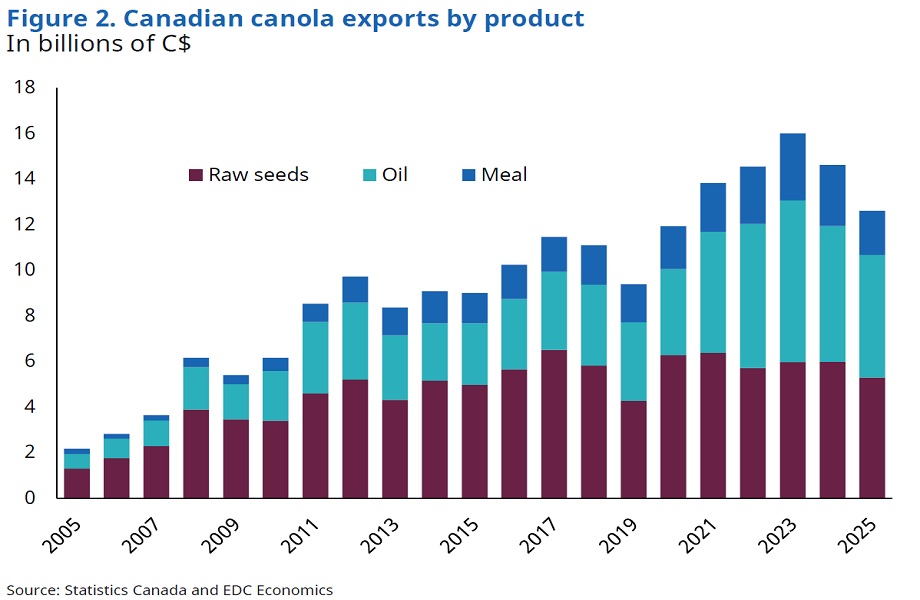
- Canada is capturing more value from canola: More than half of raw canola produced in Canada is processed domestically, while oil and meal account for a growing share of canola exports reaching almost 60% in 2025.
- The next opportunity lies further down the value chain: Capturing more value from renewable fuels and other refined products will require investment in refining, transportation and research, supported by greater policy certainty.
- Infrastructure turns processing capacity into export growth: Canada needs reliable, connected infrastructure to move canola from farms to processors and international buyers.
Canada’s agricultural strength depends on its ability to move commodities and food products efficiently to global markets. In 2025, Canada’s agriculture and food exports reached about $102 billion, accounting for 13% of total goods exports. That success relies not only on fertile land and productive farmers, but also on the interconnected transportation, storage and processing infrastructure that moves farm inputs, crops and processed goods.
Looking at one product—canola—can show how trade-enabling infrastructure can strengthen export competitiveness and help capture more value from trade. Its integrated supply chain connects farms with grain elevators, processing plants, rail corridors and port terminals. The capacity and reliability of that infrastructure determines how effectively Canada can respond to growing international demand for food, animal feed and renewable fuels.
Export Development Canada’s (EDC) white paper, From resources to resilience: How Canada can capture more value through trade, argues that Canada’s trade strategy must focus not only on increasing exports, but also on retaining more of the value those exports generate. For Canada’s canola sector, that raises two important questions: What infrastructure does Canada need to move further up the canola value chain, and where should infrastructure investments be directed?
“Canada has a globally recognized canola industry, but increasing the value we capture at home will depend on the infrastructure connecting farmers, processors and international buyers. Reliable transportation, expanded refining capacity and continued innovation can help Canadian companies move further up the value chain,” says Ashley Kanary, EDC’s director of Global Agri-food.
You should also check out
See what’s driving Canada’s exports and what EDC forecasts for key sectors through 2028.
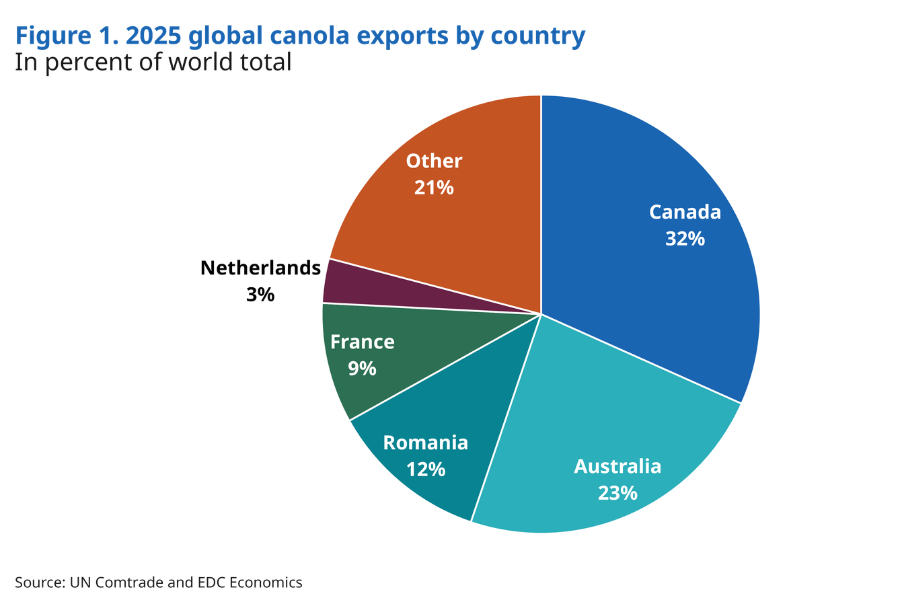
Canada is the world’s largest producer and exporter of canola (Figure 1). As the second-highest source of farmers’ agricultural sales revenue, canola contributes to gross domestic product (GDP) and jobs across Canada. After harvest, canola crops follow two main paths: Raw seeds are exported for crushing and consumption abroad or crushed domestically into oil and meal. Investments in domestic crushing capacity have more than tripled the volume of seed crushed in Canada over the past two decades, with processed products now accounting for almost 60% of canola exports (Figure 2).
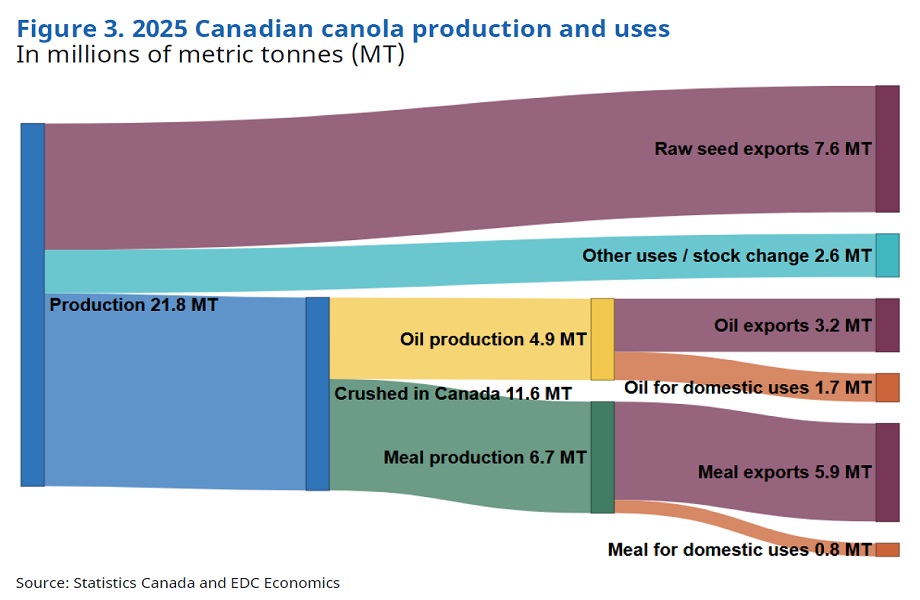
In 2025, Canada produced about 22 million metric tonnes (MT) of canola, of which 35% was exported as raw seeds, 53% was crushed domestically and 12% was allocated to other uses (Figure 3). Most canola seed exports pass through the Port of Vancouver (85%) en route to Asian buyers, with some also shipped through the Port of Prince Rupert. Europe-bound shipments travel by rail from the Prairies to the Port of Thunder Bay, then through the St. Lawrence Seaway.
Seeds destined for domestic processing are crushed into oil and meal. Oil can be further refined for consumer and industrial products. Processing canola in Canada requires capital-intensive investments in crushing plants, storage, utilities and equipment to load trains and handle seeds and oil.
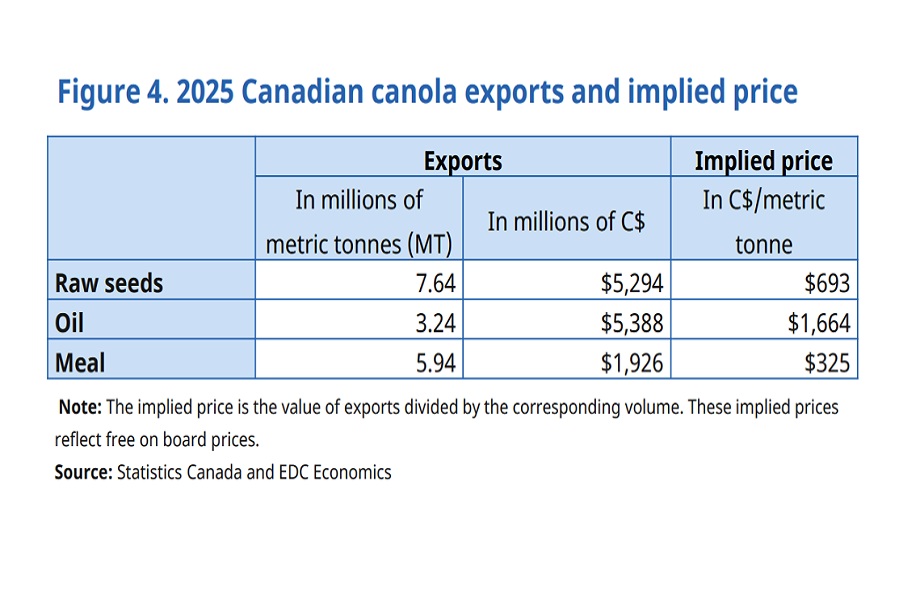
Export data indicate that the implied price for canola oil—the value of exports in dollar terms divided by the export volumes—is more than double the price of raw canola seeds per MT (Figure 4). While implied prices don’t measure profitability, they suggest greater economic activity is associated with higher-value processed canola. At Canada’s current stage in the canola value chain, each additional metric tonne of seed grown could generate up to $1,600 in revenue across seed production and crushing. According to EDC Economics’ estimates, expanding into biofuel refining could raise that total to $2,300—a 45% increase over the current level.
Thank you for reaching out to EDC.
Please watch your inbox for our email.
Loading
Thank you for applying for coverage under your PSG Margin.
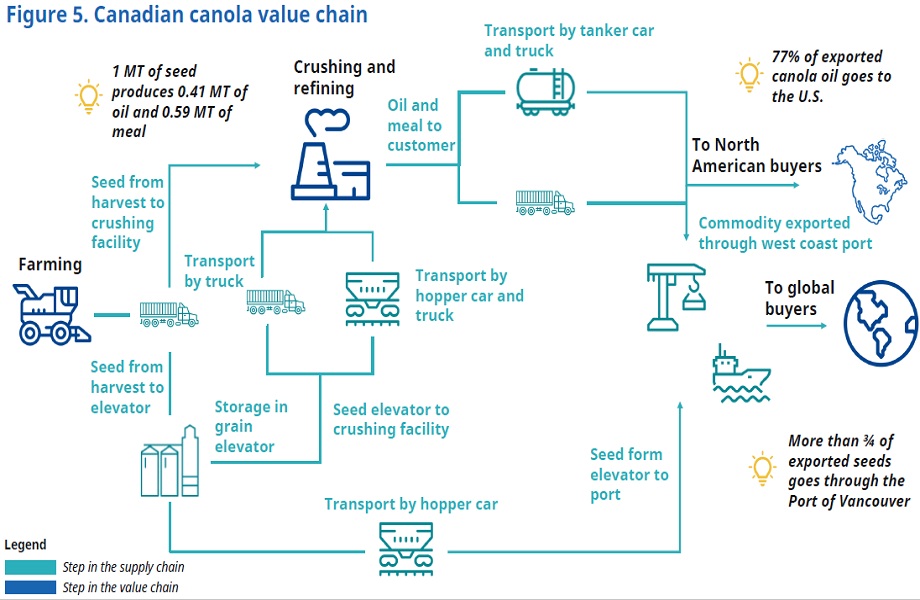
Canada’s canola sector is underpinned by an interconnected transportation network, starting before harvest and extending from farms to processors and export gateways (Figure 5). Roads and railways deliver inputs such as seed, fertilizer and fuel, while on-farm bins and elevators store harvested seed throughout the crop year. Trucks move seed to elevators or directly to crushing plants, with the destination shaped by prices, long-standing commercial relationships and available delivery capacity.
From there, the infrastructure needs differ, depending on whether the seed is exported or processed in Canada.
- Seed exported for processing abroad is collected at grain elevators, carried in hopper cars and transferred through dry-bulk terminals and vessels, primarily through Vancouver and Prince Rupert for Asian and Middle Eastern markets and Thunder Bay for Europe and Africa.
- Domestic processing relies on specialized networks to link producers and processors to global markets. Crushing plants need dependable access to seed, storage, utilities and rail-loading capacity. Once the seed is processed, oil moves largely in tanker cars and liquid-bulk vessels, while meal is shipped to markets by truck, rail or marine transport.
How Canada can capture more value from canola
Expanding domestic crushing capacity was an important first step in moving up the value chain. The next opportunity is to refine more crude canola oil in Canada for renewable biofuels rather than exporting it for processing.
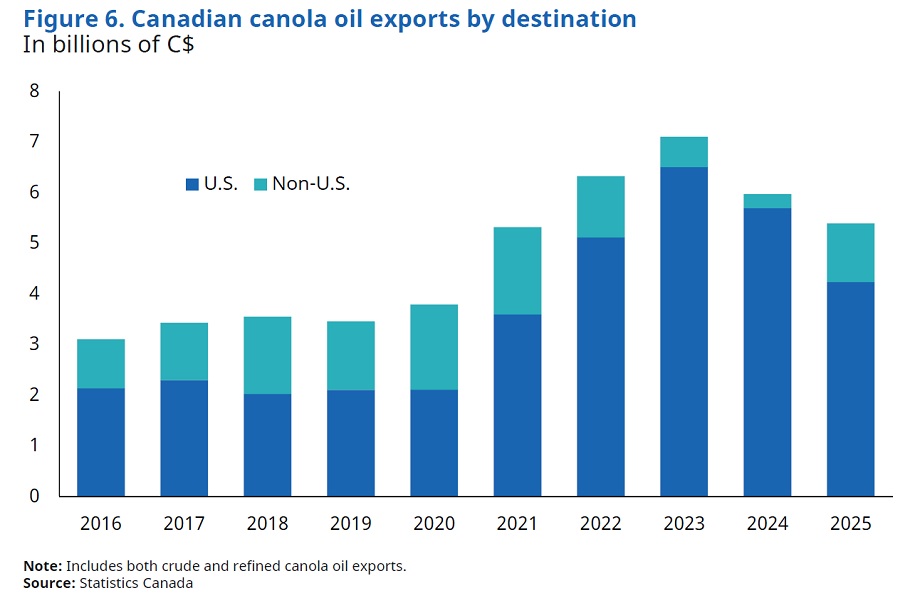
Strong U.S. demand, incentives and biodiesel blending policies mean most exported Canadian canola oil is shipped to the U.S. as low-carbon fuel feedstock (Figure 6). In fact, one in three acres of Canadian-grown canola supplies the biofuel market abroad and is re-imported as refined biodiesel.
Canadian canola exports remain concentrated in the early stages of the canola value chain, whereas the highest value-added processing occurs outside Canada. While Canada earns export value from canola, other countries capture more of the downstream economic benefits by turning canola oil into finished products. Capturing more of that value domestically will require improvements in enabling conditions and investments in large-scale physical and innovation infrastructure.
Creating the right conditions for canola investment
Reliable transportation and policy certainty can support domestic demand for canola and long-term investments in the sector. Together, these conditions can help processors plan for feedstock deliveries and reach buyers while also strengthening project fundamentals of new canola processing and oil refinery facilities.
Building infrastructure to refine more canola oil in Canada
Moving up the canola value chain requires Canada to build oilseed refinery facilities that are commercially viable and well-connected to the existing infrastructure networks. Co-processing, which uses existing oil refineries to process renewable feedstocks, could provide an opportunity to climb the value chain. Imperial’s Strathcona facility is one example. Expanding co-processing would require significant investment. Meeting the expected growth in demand for biofuels will require more supply chain capacity to store, process and transport canola outputs.
Investing in canola research and innovation
Increased refining will also require a reliable supply of canola feedstock. Research and development (R&D) into higher-yielding, higher-oil and disease-resistant seed varieties could help ensure that growing domestic processing capacity has sufficient feedstock without constraining raw seed exports. This will require continued investment in research, testing and commercialization networks.
The bottom line: How Canada can capture more value from canola
Canada has made meaningful progress beyond raw seed exports by expanding domestic crushing, but the next stage of value capture will depend on refining more canola oil at home. Moving further up the value chain will require infrastructure that efficiently connects processing capacity to domestic refineries and export markets, supported by research and innovation, stable policy and strong investment conditions.
EDC helps Canadian agri-food companies expand production, enter new markets and manage the risks of international growth. Through financing, credit insurance, market intelligence and connections to global buyers, EDC can support companies investing in processing capacity, strengthening supply chains and pursuing new export opportunities.
Learn more about EDC’s support for Canadian agri-food exporters.
Acknowledgments
We’d like to thank the experts at Agriculture and Agri-Food Canada, Canola Council of Canada and SaskOilseeds who shared their time and insights. Their contributions helped strengthen the analysis in this report.